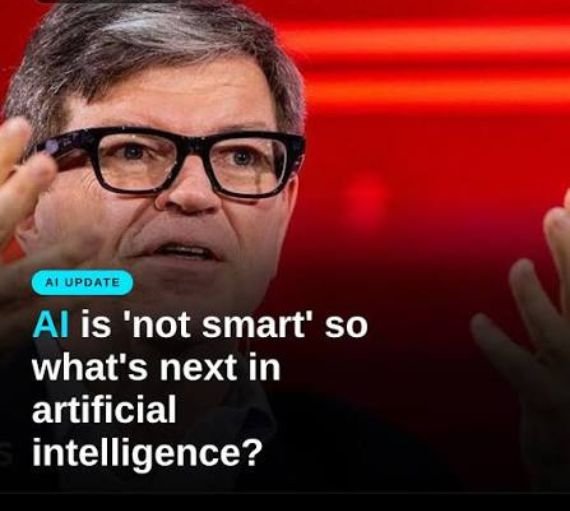
If AI Isn’t Truly Smart, What Comes Next?
Beyond ChatGPT: Building AI That Understands the Real World
“We don’t have robots that are nearly as good at understanding the physical world as a rat,” says Yann LeCun, one of the most influential figures in artificial intelligence.
LeCun spent a decade at Meta, where he served as chief AI scientist, before leaving the company in 2025 to establish Advanced Machine Intelligence Labs, known as AMI Labs. His ambition is to push artificial intelligence beyond the capabilities of today’s leading systems, including ChatGPT, Claude, and Gemini.
LeCun acknowledges that these systems are remarkably useful, particularly when it comes to generating text, solving mathematical problems, and writing code. But he argues that they remain fundamentally limited because they do not truly understand the physical world.
“They’re not a path towards human-level or human-like intelligence, or even animal-like intelligence, because they cannot deal with real-world data. They just are not built for that,” he says.
Speaking on the sidelines of VivaTech, France’s leading technology conference, LeCun explains that AMI Labs is developing a different approach to artificial intelligence, one that does not rely on the technology behind today’s large language models.
The company has already attracted significant attention from investors. Earlier this year, AMI Labs announced that it had raised more than $1 billion in seed funding, with investors including U.S. semiconductor giant Nvidia and the investment fund managing the private wealth of Amazon founder Jeff Bezos. The funding round was among the largest early-stage technology investments in Europe.
Beyond What AI Can Predict
Large language models, or LLMs, are extremely capable within certain boundaries. They can write sophisticated software, solve complex mathematical problems, generate detailed explanations, and produce convincing human-like text.
But LeCun argues that these tasks are largely based on well-defined patterns and predictable forms of information.
“They basically just accumulate knowledge,” he says. “They can regurgitate something. You train them to regurgitate, but they’re not particularly smart. They don’t have an underlying understanding.”
The distinction becomes more obvious when AI is confronted with the unpredictable nature of the physical world.
LeCun illustrates the problem with a simple experiment. He holds a pen upright on its tip and asks what will happen when he lets go.
Even a young child understands that the pen will fall. But there is no practical way to know exactly which direction it will fall before it happens.
An LLM, however, might attempt to produce a specific prediction based on statistical patterns learned from enormous amounts of training data. The answer may sound convincing, but it is unlikely to reflect genuine physical reasoning.
The problem is not simply that the prediction could be wrong. It is that the system is not necessarily building an internal understanding of why the pen falls in the first place.
LeCun believes this is where a fundamentally different approach to AI could make a difference.
Teaching AI to Understand the World
AMI Labs is developing a system known as Joint Embedding Predictive Architecture, or JEPA. Rather than attempting to predict every possible detail of the world, the technology is designed to build abstract representations that help an AI system understand what matters.
These abstractions allow the system to focus on meaningful information while filtering out details that are irrelevant to a particular task.
In the example of the falling pen, the system would not need to calculate every possible movement or determine the precise direction of the fall. Instead, it could understand the broader physical reality: the pen is unstable, gravity will cause it to fall, and its exact trajectory cannot be reliably predicted in advance.
That kind of flexible understanding could be critical if AI is ever expected to operate safely in the physical world.
The Next Frontier: Robots
The robotics industry has a major stake in solving this problem.
Billions of dollars are being invested in humanoid robots, and their capabilities are improving rapidly. Machines can now perform increasingly complex movements, manipulate objects, navigate environments, and demonstrate impressive coordination.
Yet seemingly ordinary household tasks remain extremely difficult.
Teaching a robot to safely iron clothes, load a dishwasher, organize objects, or respond to an unexpected situation requires far more than recognizing objects and following instructions. The machine must understand its surroundings, anticipate consequences, adapt to uncertainty, and make decisions based on changing conditions.
LeCun believes today’s dominant AI models are unlikely to solve these challenges on their own.
The next generation of AI may therefore depend on systems that can build internal representations of the world rather than simply process language.
The Rise of World Models
LeCun is not alone in pursuing this direction.
Ingmar Posner, professor of Applied Artificial Intelligence at the University of Oxford and director of its Applied AI Lab, believes the next decade could focus heavily on AI systems capable of explaining how the world works.
“My view is that the next decade will really be about systems that can explain,” Posner says. “You need models that can answer questions like: What matters? What causes what? What would happen if I did something else, like if I took a different action?”
Posner and his team of researchers have spent years developing an alternative approach broadly described as World Models.
The concept itself is not new. Researchers have explored the idea for decades, but advances in machine learning and computing power have made it increasingly practical.
One influential contribution came from researchers David Ha and Jürgen Schmidhuber, whose 2018 work demonstrated how an AI system could potentially learn by creating an internal simulation of its environment.
Instead of simply reacting to what is happening, an AI equipped with a world model could imagine possible futures, compare potential outcomes, and then choose an appropriate action.That idea has since sparked significant research across the AI industry.
Google DeepMind, for example, has developed its Genie series of world models. Other projects include Gaia from London-based autonomous driving company Wayve and work from World Labs, the San Francisco-based AI company founded by AI pioneer Fei-Fei Li.
From Language Models to World Understanding
The promise of world models is not simply to make AI better at answering questions. It is to make AI better at understanding situations.
Posner describes his team’s approach as a “mechanistic world model,” designed to organize knowledge in a way that can be efficiently recalled, combined, and modified when circumstances change.
“You need systems that are able to compartmentalize and organize knowledge in such a way that it can be recalled, combined, and modified when it matters,” he says.
The challenge is determining how long it will take to develop such systems.
Technological breakthroughs often arrive faster than experts expect. Before ChatGPT was launched in November 2022, many researchers might have predicted that a system with its capabilities was still decades away.
That uncertainty makes the next stage of AI particularly difficult to predict.
What Comes After Today’s AI?
For LeCun, the immediate goal is practical rather than futuristic.
AMI Labs plans to spend the rest of the year refining its technology, with hopes of putting the system to work in industrial environments the following year. If those early applications prove successful, the ambitions could become considerably larger.
Eventually, LeCun envisions general-purpose intelligence systems capable of being applied to a wide range of real-world problems with minimal additional training or fine-tuning.
That could fundamentally change the relationship between humans and machines.
If robots and AI systems become capable of understanding their surroundings, anticipating outcomes, and operating independently, what role will humans play?
LeCun does not believe people will become irrelevant.
“We’re still going to need humans to figure out what questions to ask, what to build, what to create, which is really the properly human aspect,” he says.
In his vision, AI will increasingly work alongside people rather than simply replace them.
“Our interaction with future AI systems, even if they are smarter than us, is going to be like the interaction between a captain of industry or a political leader with their staff of assistants, many of whom are smarter than they are.”
The future of artificial intelligence, then, may not be about building machines that simply know more.
It may be about building machines that understand more, imagine possibilities, learn from the physical world, and know what could happen before they act.That could mark the beginning of a new era in AI, one that moves beyond language and toward genuine understanding of the world around us.